



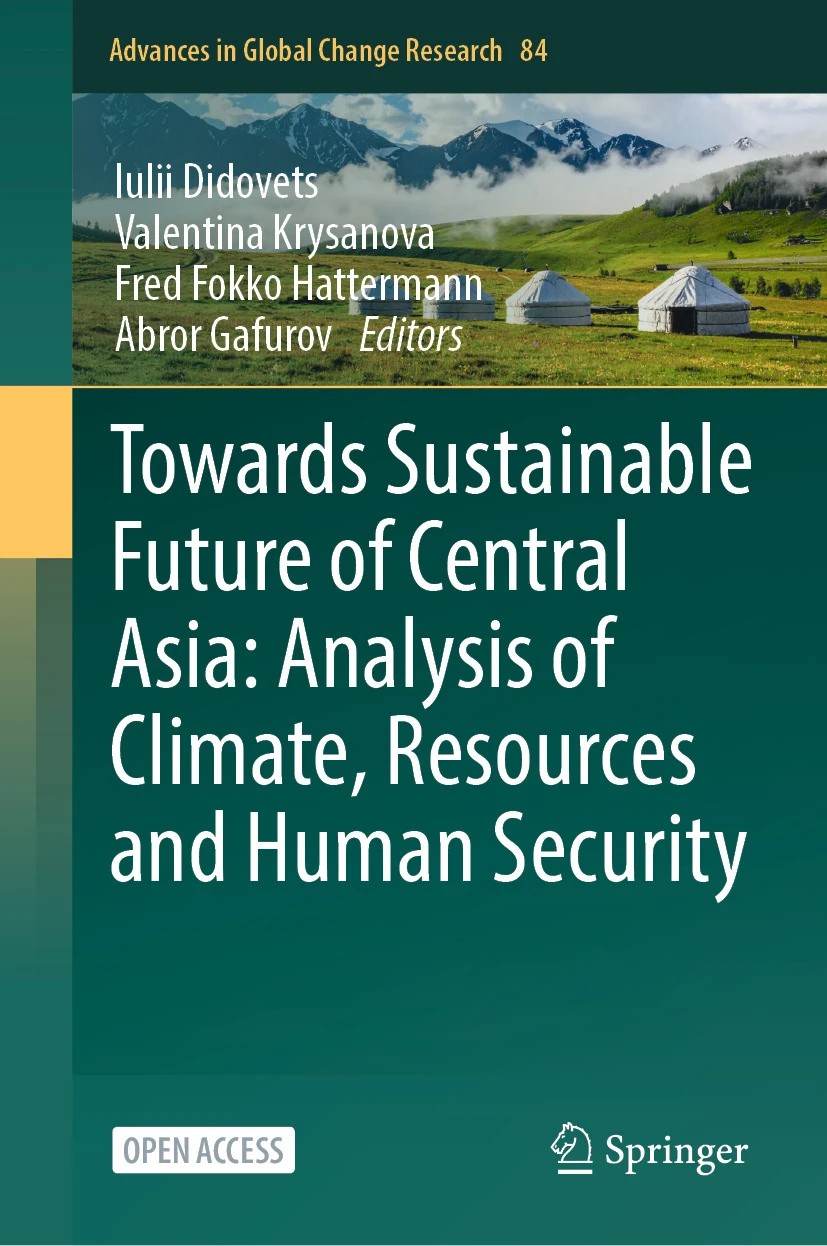
Researchers from the Potsdam Institute for Climate Impact Research (PIK) have led a new open-access book on climate change in Central Asia, published by Springer in the series Advances in Global Change Research. “Towards Sustainable Future of Central Asia: Analysis of Climate, Resources and Human Security” (https://link.springer.com/book/10.1007/978-3-032-29989-5) was edited by Iulii Didovets, Valentina Krysanova and Fred Hattermann (PIK) together with Abror Gafurov (GFZ Helmholtz Centre for Geosciences). It brings together 86 authors from 37 institutions in nine countries, many of them based in Kazakhstan, Kyrgyzstan, Tajikistan and Uzbekistan.
The book is the first to assess climate change and its impacts across all five Central Asian countries and across sectors. Its 16 chapters cover climate trends and CMIP6-based projections, the cryosphere and mountain hazards, water resources, agriculture and the water–energy–food nexus, health, protest and peacebuilding. Each chapter summarises the current state of knowledge and also names the gaps where more research and funding are needed. That makes the book a reference both for policymakers and for setting future research priorities in the region.
The overall picture is of a region in rapid transition. Central Asia is warming faster than the global average and its glaciers could lose up to 85 percent of their volume by 2100. “Glacier-fed rivers are currently receiving additional meltwater, which temporarily increases water availability,” says Iulii Didovets. “But this is a temporary effect: once ‘peak water’ is passed, expected around the middle of the century, flows will decline, and in the Tien Shan much sooner than in the Pamir.” While annual river discharge is projected to increase in most Central Asian basins, summer flows from July to September are expected to decline by up to 50 percent, depending on the scenario. This hits the growing season, when irrigated agriculture, which accounts for up to 92 percent of water withdrawals in some countries, needs water most. At the same time, upstream countries rely on hydropower for most of their electricity, so shifting river flows will sharpen competition between irrigation, energy production and transboundary water sharing.
The authors also see climate change as a risk multiplier for social tensions, but find that shared water and climate challenges can open new avenues for cooperation between the five countries.


