



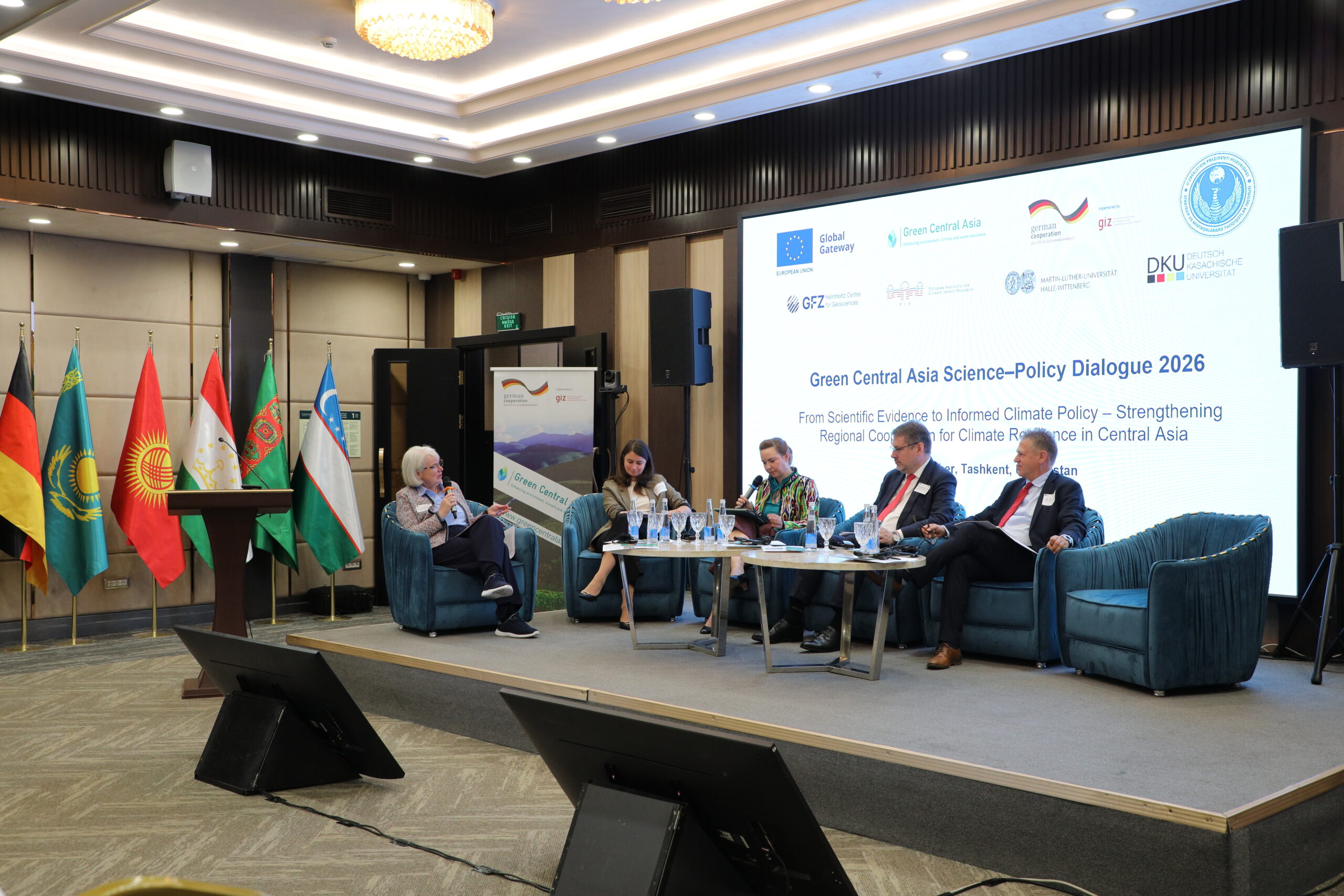
On 8-9 October 2026, a dialogue between representatives of science and policy was held in Tashkent, bringing together representatives of government authorities from Central Asian countries, scientists, hydrometeorological services, international organisations and development partners.
The event was co-organised by the Institute for Strategic and Interregional Studies under the President of the Republic of Uzbekistan (ISRS) and the Deutsche Gesellschaft für Internationale Zusammenarbeit (GIZ).
Under the overarching theme ‘From Scientific Evidence to Informed Climate Policy – Strengthening Regional Cooperation for Climate Resilience in Central Asia‘, participants discussed how scientific data and modern tools can contribute to more informed decision-making and strengthen regional cooperation on climate, water and environmental issues.
The discussions focused on climate forecasting, drought monitoring, cryosphere research, water monitoring and climate risk assessment, as well as opportunities for the practical application of scientific findings in policy and planning.
Amb. Eduard Stiprais, EUSR for Central Asia, underlined: “The climate crisis is accelerating, but we are not powerless. By bringing countries and regions together, and by closing the gaps between science and policy implementation, we can forge clear paths forward. This workshop is a vital step toward that goal, reflecting also the EU’s long-term commitment to remain a reliable partner in this collaborative fight.”
Ms. Anne Vanselow, Head of Division, Climate Diplomacy, Federal Foreign Office noted: ‘For Germany, climate and security are closely intertwined. Central Asia is the world’s prime example for this connection: Growing populations, complex borders, unevenly distributed water resources that are dwindling at an alarming rate. On top of that, a volatile geopolitical environment. Climate and water cooperation is literally becoming a matter of life and death in Central Asia and I am proud of Germanys strong support through our GIZ project.’
Ms. Christiane Amari, Federal Ministry for economic Cooperation and Development stressed: This dialogue is based on a simple but important conviction: scientific knowledge must not remain within research institutions or reports. It must reach the people who take decisions. It must inform policies, guide investment and help societies prepare for risks before they become crises.
Mr. Akramjon Nematov, First Deputy Director of ISRS under the President of the Republic of Uzbekistan, noted: “For Uzbekistan, climate policy must be grounded in scientifically validated data. At the initiative of President Shavkat Mirziyoyev, the climate and environmental agenda has become part of the country’s long-term development strategy. National reforms are already producing measurable results, but climate risks do not stop at national borders. The next step is to translate the Regional Strategy for Adaptation to Climate Change into joint projects with compatible data, trained specialists, clear indicators and access to climate finance. This is where we see the practical value of the Green Central Asia initiative.”
The first day – the High-Level Science–Policy Dialogue focused on interaction between science and policy. Participants discussed the role of the ‘Green Central Asia’ initiative in strengthening regional climate cooperation, the link between scientific knowledge and policy priorities and international partnerships, as well as common climate priorities of Central Asia on the way to COP31.
A separate session was dedicated to the topic of “One Region, One Voice’, and the discussion of common climate priorities and regional messages from Central Asia to COP31 in Antalya. Representatives of the five countries of the region, Germany and the European Union exchanged views on opportunities to strengthen regional cooperation and coordination.
On the second day, scientists presented practical results and tools, including research on drought preparedness, climate impact modelling, water resources and cryosphere monitoring. Participants also discussed how this knowledge can be used for decision-making.
The second day – the ‘Partnership Forum’ focused on moving from dialogue towards further cooperation. During the session on shaping a common agenda, participants considered regional climate priorities in the context of the Central Asia–Germany process and the planned Regional Partnership on Environment and Climate.
Particular attention was given to the coordination of international initiatives and identifying opportunities for closer interaction among partners working in the field of climate resilience in Central Asia.
As part of the final thematic session, ‘Looking Ahead – Preparing Central Asia for Tomorrow’s Climate Risks’, experts and representatives of Central Asian countries discussed the region’s future climate risks. Key topics included climate change, future availability of water resources, the impacts of glacier change, risks to agriculture and food security, as well as the interlinkages between climate, natural resources and human security.
The programme concluded with an interactive ‘Coffee with Scientists’ session, where participants became familiar with scientific tools, demonstrations and digital products, discussed their practical application and had an opportunity to communicate directly with researchers.


