


On 6-7 October 2026, a regional dialogue on environmental governance took place in Tashkent, bringing together representatives of civil society, Youth Advisory Councils, expert communities, regional thematic working groups and international organisations to discuss joint approaches to the climate and environmental challenges facing Central Asia. Particular attention was given to the role of women and young people in shaping climate-resilient policies and promoting sustainable water and energy management.
The event provided a platform for exchanging experiences, discussing regional priorities and developing practical recommendations to strengthen environmental governance and regional cooperation. Participants addressed climate policy and a just transition, regional environmental cooperation, public participation, climate data transparency and public monitoring.
A key focus was on strengthening collaboration between public institutions, civil society, experts and youth organisations. Discussions explored how existing recommendations could be translated into practical initiatives, partnerships developed and a shared regional vision for future action established.
On the first day, participants examined key climate trends in Central Asia, environmental justice and law, and the objectives and mechanisms of the Team Europe Initiative (TEI) on Water, Energy and Climate Change.
Thematic working groups focused on four areas: climate policy and a just transition; regional environmental and climate cooperation; civil society participation and public engagement; and climate data collection, transparency and public monitoring.
The groups presented their recommendations and identified priority areas for further regional cooperation. Participants also discussed funding opportunities and practical mechanisms for implementing projects that address shared climate and environmental challenges.
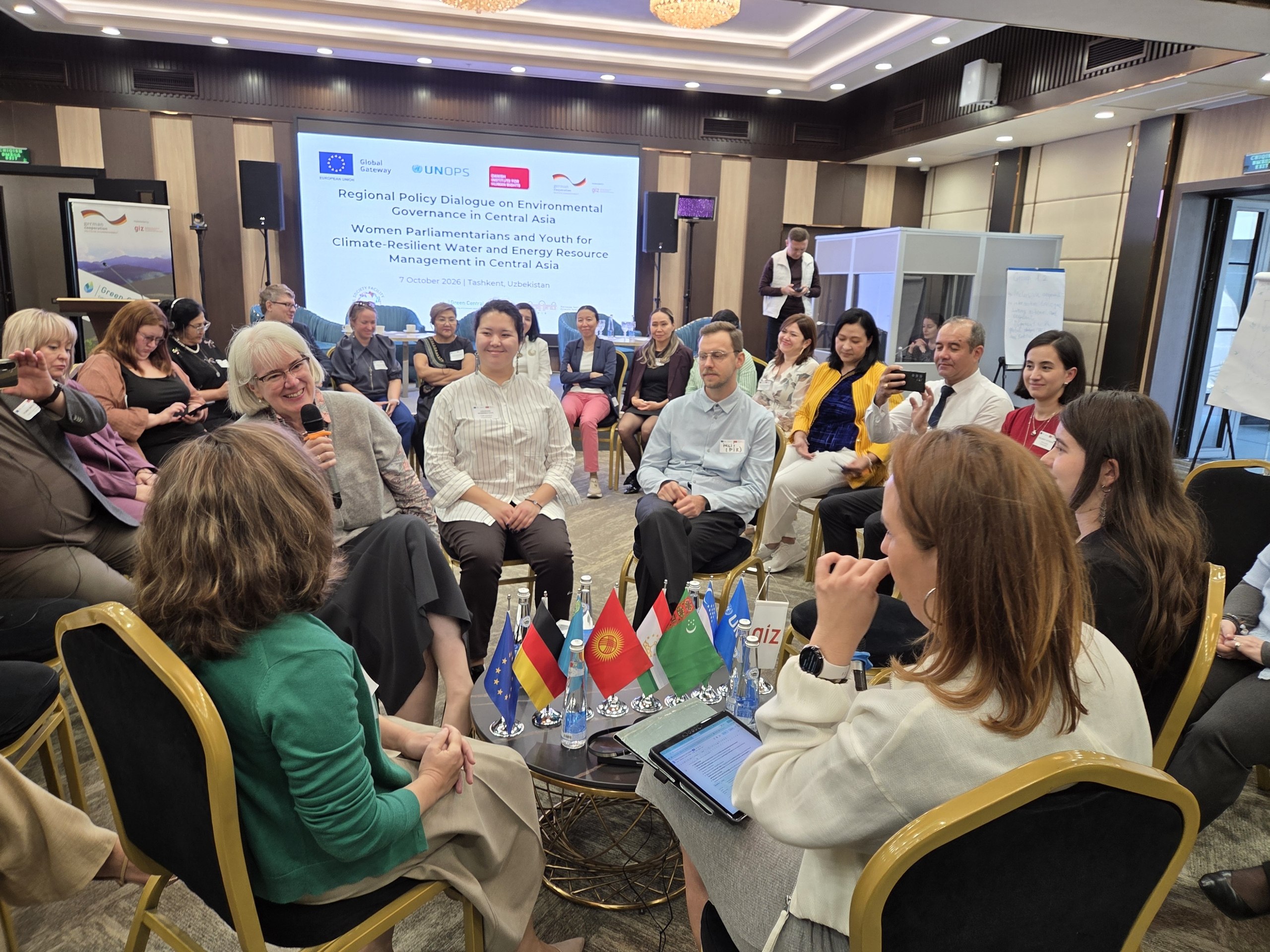
The second day featured a dialogue entitled “Women Parliamentarians and Youth for Climate-Resilient Water and Energy Governance in Central Asia”, held within the framework of the Green Central Asia II project.
Participants explored ways to strengthen the involvement of women and young people in policymaking on climate change, water resources, energy and sustainable development. Particular attention was given to the role of women parliamentarians, women’s professional networks and youth initiatives in advancing inclusive solutions and regional cooperation.
Interactive formats, including Fishbowl discussions and World Café sessions, enabled participants to exchange experiences and develop proposals in four areas: parliamentary action, women’s networks, youth engagement and cross-sectoral cooperation.
Examples from the Kafirnigan and Syr Darya Basin Women’s Forums and the Women in Water Diplomacy network in Central Asia highlighted the importance of connecting regional initiatives and expert knowledge with the needs of local communities.
The dialogue highlighted the importance of inclusive environmental governance in Central Asia. Sustainable solutions require not only scientific knowledge and coordinated policy priorities, but also the meaningful involvement of diverse groups in shaping and implementing them.
The event was jointly organised within the framework of three projects: the European Union-funded EU Civil Society Facility for Central Asia (UNOPS/DIHR); EU4SustainableCentralAsia: Joint Action and Cooperation on Water, Energy and Climate Change*, co-financed by the European Union and implemented by GIZ; and Green Central Asia II, funded by the German Federal Foreign Office. Partners and expert organisations involved in the dialogue included the German Council on Foreign Relations (DGAP), the Potsdam Institute for Climate Impact Research (PIK) and the Danish Institute for Human Rights (DIHR).


