




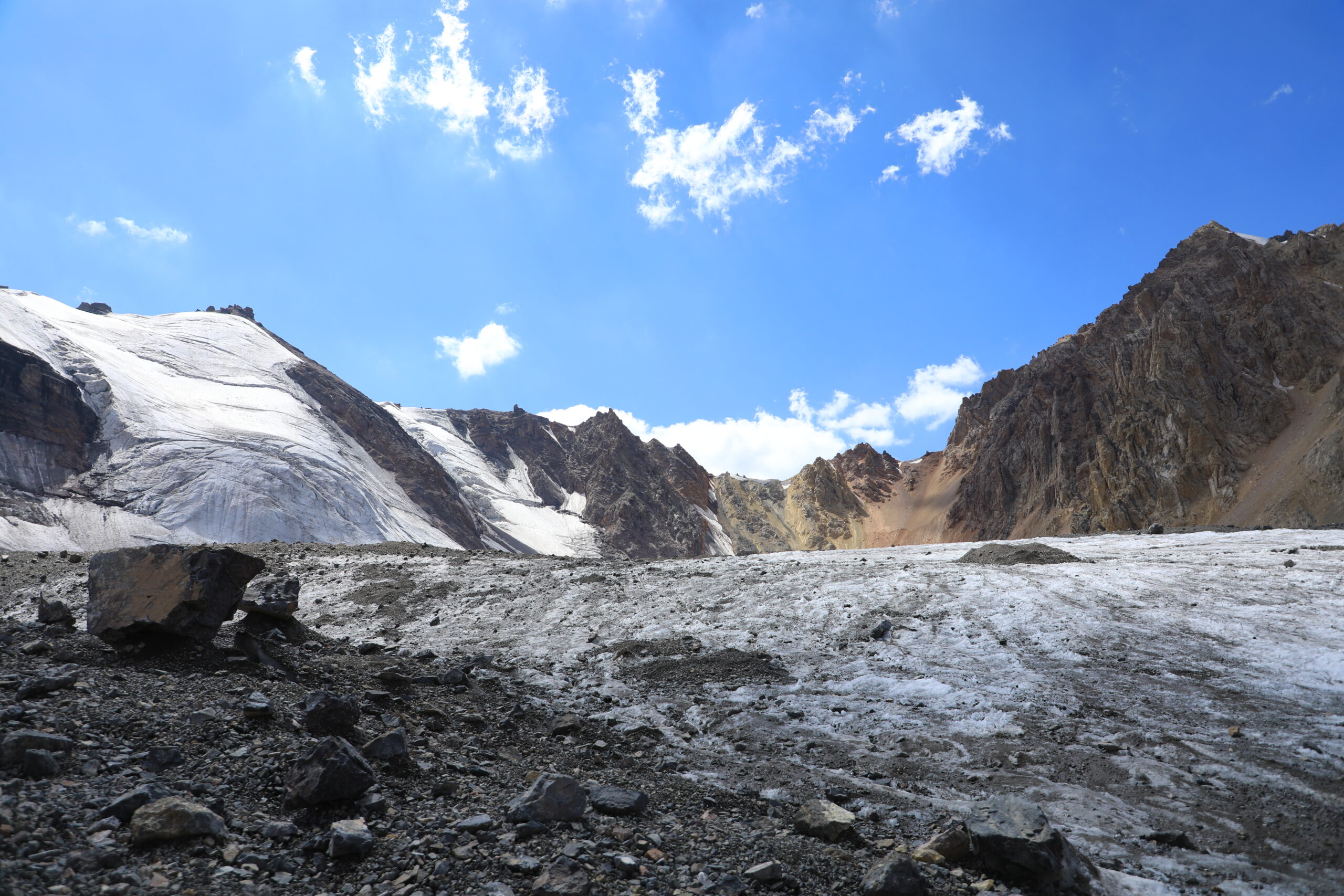
On August 8-18, 2025, a multidisciplinary expedition was organized to the “Barkrak-medium” glacier located in the Pskem range in the Republic of Uzbekistan. Upon arrival in Tashkent, participants took a mandatory briefing covering safety protocols, regional topographic features, climatic conditions, and methodological approaches to field research. Furthermore, they were acquainted with the wide experience of the Glacial Geology Centre in glaciological research and fieldwork.
Participants visited the Maidontol meteorological station located on the largest sources of Pskem River – Maidontol River originating in Kazakshstan and Oigaing River fed by Bakrkak melted water, among others. After inspecting Maidontol and Oigaing meteorological stations, expedition focused on hydrological investigations of the Barkraksay River, including water sampling, flow measurements, and analysis of physico-chemical parameters. These data are critical for assessing the impact of glacier degradation on the region’s hydrological balance and water availability downstream.
The glaciological works mainly focused on the monitoring of mass balance changes in the ablation zones (glacier tongue) and the monitoring of current snow cover in the accumulation zones of accessible. In addition to traditional glacier monitoring, drone photogrammetry and digital geodetical survey were used to safe and efficient monitoring of glacier stages. Expedition continued measuring flow in streams coming from glaciers and moraines. The expedition’s members found a large, unspecified underground water storage in the moraine which has not been investigated before.
The final stage of the expedition involved the initial processing of the collected measured data. A concluding session was held, allowing for interdisciplinary exchange of results and discussions on future research prospects.
All collected and measured data requires post-expedition analysis and expert evaluation to determine precise future development of glaciers and to quantify the impact of melting glaciers on human activities and ecosystems. Therefore, such collective scientific expeditions must continue in the future regularly with more intensive support of up-to-date equipment, strengthening capacity building, gender equality and international networking of experts.
A key feature of this expedition was to bring the experts working in glaciology and to enable them to share their deep experiences with each other. Furthermore, the active involvement of women scientists from Central Asian countries — Kazakhstan, Kyrgyzstan, Tajikistan and Uzbekistan was supported. Representatives from both academic and applied scientific institutions actively contributed to all stages of the fieldwork — from planning and logistics to the execution of high-precision measurements under high-altitude conditions. Both, female and male experts in hydrology, glaciology, geophysics, and geodesy were responsible for data collection, equipment setup and operation, as well as processing information from autonomous recording systems. Their scientific competence, physical endurance, and professional training played a vital role in the successful implementation of the research tasks.


