




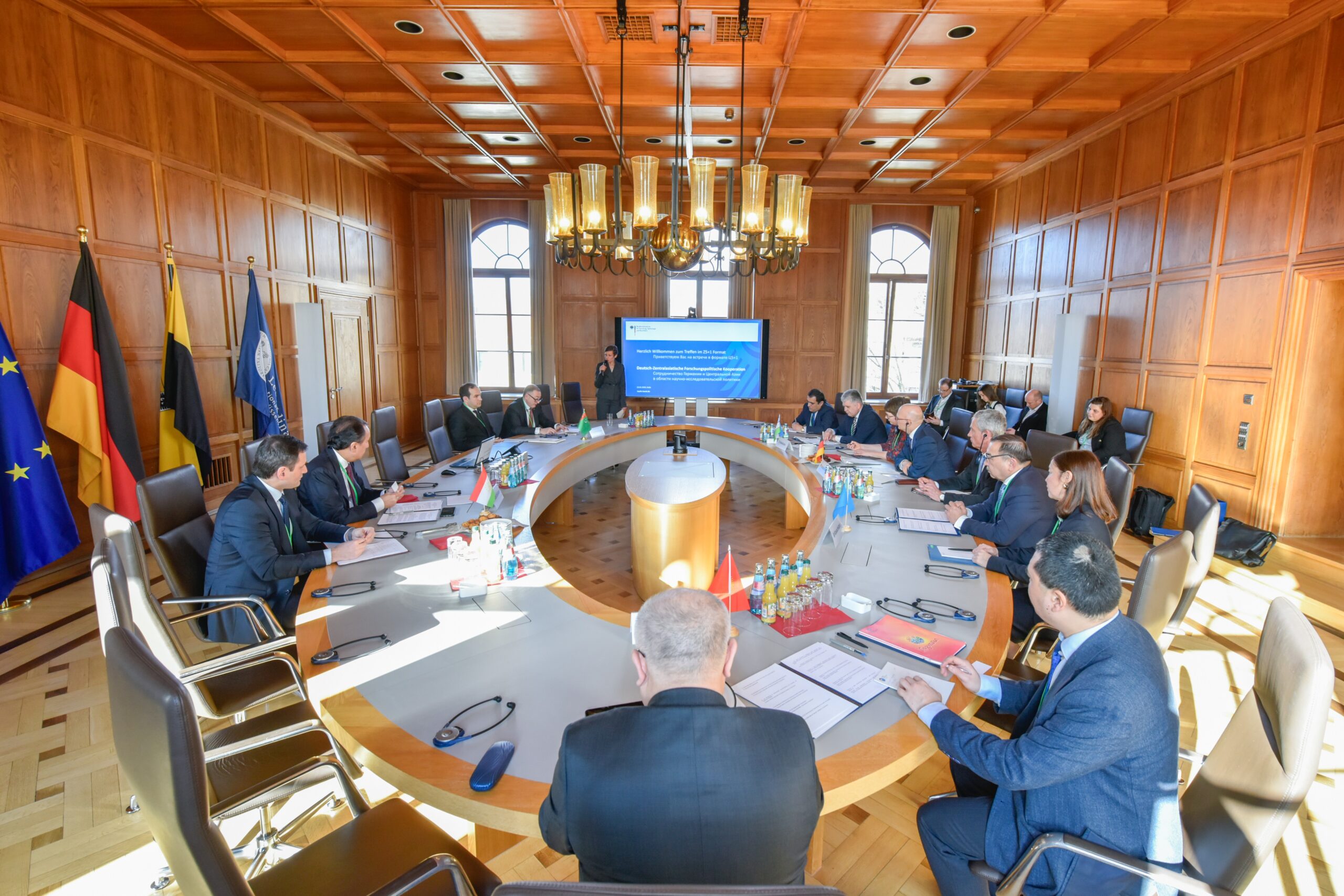
The Green Central Asia Initiative participated in the first German Higher Education and Science Forum Central Asia, held from 23 to 25 February 2026. The forum was organized by Martin Luther University Halle-Wittenberg (MLU) in cooperation with the Central Asia Sustainable Innovation Bureau (CASIB), with the support of the Federal Ministry for Research, Technology and Space. The event was hosted within the framework of the strategic regional partnership in the C5+1 format.
The forum aimed to strengthen networking among German universities and research institutions seeking to deepen their cooperation with the countries of Central Asia and to explore new avenues for collaboration. The MLU maintains long-standing and active partnerships with universities across the region. As part of these activities, MLU established its international representation in Almaty-an exceptional feature within the German higher education landscape. The representation supports cooperation with Central Asian universities and research institutes through federal research funding programmes and is deeply embedded in regional scientific networks. This opens a wide range of promising research fields in both basic and applied sciences, including energy transition, climate adaptation, sustainable land use and regional development, biodiversity enhancement, food security and health, as well as social participation.
In her opening remarks, MLU Rector Prof. Dr. Claudia Becker welcomed more than 180 participants from research, politics, and research funding organisations, emphasising MLU’s strong ties with Central Asia. The region faces numerous challenges-from demographic and economic developments to water and food security, energy supply, and global issues such as climate change. “In one word: transformation is the central theme that the states must address intensively,” Becker noted. Transformation is also one of MLU’s three profile lines, shaping research and teaching across the university. For sustainable engagement in Central Asia, a local anchor point is essential. Since 2019, MLU has maintained a foreign representation in Almaty, Kazakhstan. Attached to it is CASIB, which is funded by the Federal Ministry for Research, Technology and Space. CASIB supports the transfer of innovations and project results, connects federally funded projects in the Central Asian partner countries, and organises scientific exchange in the region. The head of both institutions, Dr. Peter Liebelt, has also served as the German Research Foundation’s trusted researcher for Central Asia since December 2025.
In his address, State Secretary Dr. Marcus Pleyer underlined the importance of joint projects for international relations: “Trust is the most important currency of international cooperation. It does not emerge from papers or protocols, but through personal exchange, joint projects, and resilient networks.” He added: “We rely on dialogue, cooperation, and the power of science to shape change positively and sustainably.” Shortly before the forum, he and the five ambassadors: H.E. Nurlan Onzhanov (Kazakhstan), H.E. Omurbek Tekebaev (Kyrgyz Republic), H.E. Imomudin Sattorov (Tajikistan), H.E. Berdymurat Redjepov (Turkmenistan), and H.E. Dilshod Akhatov (Uzbekistan), signed a Memorandum of Understanding on research-policy cooperation between Germany and the Central Asian states.
The forum marks the starting point for closer networking among actors committed to strengthening scientific cooperation with Central Asia. Following the successful launch, MLU and CASIB plan to establish regular exchange formats. A networking event on early-career research cooperation with Central Asia is already planned in Halle for next year.


